
Your AI is already connected to your business tools. Nobody can tell you what it can reach.
Most companies got here the same way. People started using Claude or ChatGPT for real work, connected the tools they needed, and it worked well enough that nobody stopped to ask what happens next.
We are Inform Growth. We run the layer that sits between a business and the AI it already uses. This page is about the four things that break without one, in roughly the order they break.
You can't see who has access to what.
Every person who connects a tool to their own AI creates an access path that nobody is tracking.
This is not a fringe problem. Verizon's 2026 Data Breach Investigations Report found frequent AI use by employees rose from 15% to 45% in a single year, and now ranks shadow AI, meaning employees using unapproved AI tools at work, as the third most common non-malicious data-leakage activity (Verizon, 2026).
- Someone leaves. Their AI still holds a live login to your CRM, because the connection was theirs, not the company's.
- A new hire waits days for tool access, and someone eventually over-grants because it's faster than doing it properly.
- A contractor needs one system and gets all-or-nothing keys to your stack.
- An agent runs unattended on a person's full OAuth scope, because that was the only way to give it access at all.
How it's solved
Connections live centrally instead of per person. Access is granted once and scoped to exactly what a given person or agent needs, and revoking it once removes it everywhere.
Onboarding and offboarding turn out to be the same fact seen from two ends. When access lives in one place, provisioning someone into every tool they need is a single instruction rather than a ticket queue. We onboarded a teammate into every system he needed in under ten minutes, which is not a feat of tooling so much as the natural consequence of not having thirteen separate places to grant access.
The same structure is what makes an autonomous agent safe to run. It gets one label and one object, not your whole account.
You can't see what your AI actually did.
You know your team uses AI every day. You could not produce a record of it if someone asked.
- An agent runs on a schedule and you find out it has been failing for three weeks because someone noticed the output stopped arriving.
- Half your connectors are erroring or dead and there is no dashboard that would tell you which.
- Somebody asks AI for a summary of the pipeline and gets something confident and wrong, and there is no way to trace what it actually read.
How it's solved
Every request your AI makes to a business tool passes through one place, so every one of them is recorded. Each agent action is attributed to a stated goal and closed with an outcome, which means the record is readable as work rather than as log spam. Failures get reported as tracked issues instead of disappearing into a chat window.
The reason this matters is not the audit trail. It's that you can finally see which work AI is repeatedly doing well, which is the only honest basis for deciding what to automate next.
Everyone's AI does the same job differently.
This is the one that gets noticed last and costs the most.
- Four people wrote their own version of the same lead-research prompt. All four work slightly differently. None are written down.
- The useful ones live in one person's chat history, and leave when they do.
- Two agents read the same CRM field and interpret it differently, so you get two answers to one question and no way to tell which is right.
- Every agent writes in a different voice and ignores the rules you set once.
How it's solved
A process gets published once as a skill, shared across the team, and edited in one place. Shared field definitions sit at the same layer, so every agent reads your data the same way instead of re-deriving your data model from a prompt each time.
This is the RevOps problem wearing new clothes. The definitions were always the hard part. What changed is that you now have a dozen non-human readers consuming them.
You're locked in, in ways you didn't choose.
Every integration you build inside one AI vendor's product is an integration you rebuild when you leave.
- You wire your stack into one model provider and the switching cost quietly becomes the reason you stay.
- You run AI across several clients or entities and the tools collide, or the data mixes, or you log in and out all day to keep them apart.
How it's solved
The tools connect at the layer, on the open MCP standard, rather than inside any one AI product. Swap the model and the stack survives. Each client or entity stays isolated, so one instance can work across five CRMs and five Workspaces without them touching.
In a market moving this fast, the ability to change your mind is worth more than any individual integration.
All four are the same problem.
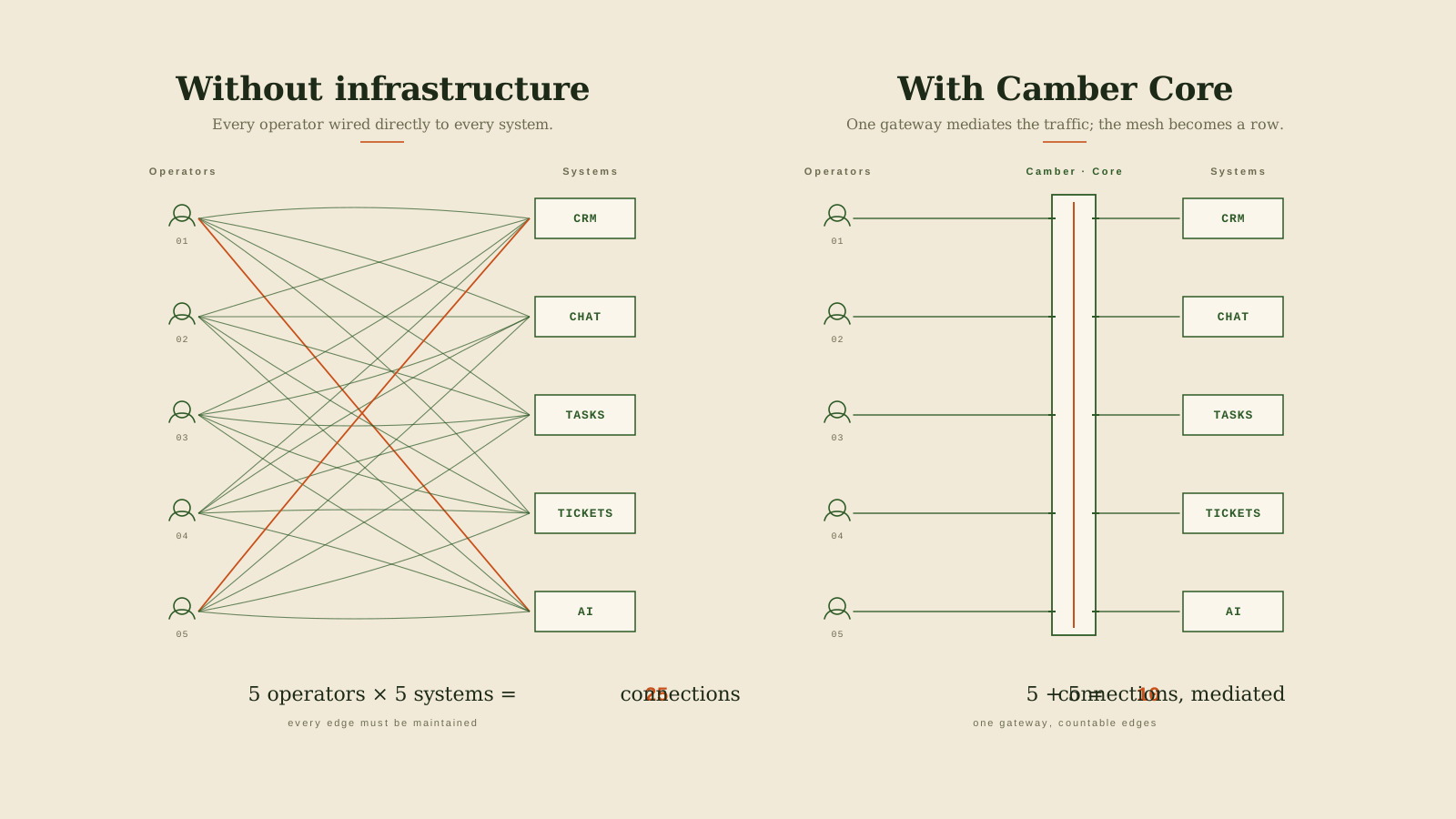
Every problem above comes from one gap: AI reaching your business tools with nothing in between.
Put one layer in that gap and the four problems become one problem, solved once. That is the whole architecture. Everything else on this page is a consequence of it.
One layer, in the gap.
Every request, from every person and every agent, goes through one place on its way to your tools. That is the entire idea. Because it all passes through one place, it can be recorded once, scoped once, and changed once, instead of thirteen times in thirteen consoles. This pattern has a name in the technical literature: an MCP gateway, built on the open Model Context Protocol standard.
Deloitte surveyed 3,235 business and IT leaders across 24 countries in April 2026. 74% expect their companies to be using AI agents at least moderately by 2027. Only 21% say they have a mature governance model in place for agentic AI (Deloitte, April 2026). That distance between the two numbers is the problem. One layer is the smallest thing that closes it.
How we work.
Most AI projects pick a process, engineer it in isolation, and then spend months trying to get from a good demo to something you would trust unattended. That gap is where they die, and the reason is that the workflow was chosen before there was any evidence it was the right one.
Gartner expects more than 40% of agentic AI projects to be canceled by the end of 2027, citing escalating costs, unclear business value, and inadequate risk controls (Gartner, June 2025).
We go the other way.
- Do the work by hand, in the AI, through the layer.
Every request gets recorded, so the work itself becomes the evidence.
- Find the repeats.
When the same task shows up across people and weeks, it is a proven candidate rather than a hypothesis. You also have a pile of your own corrections, which is what "good" actually means in your business.
- Publish it as a skill.
Run it on real work until it needs almost no correction.
- Promote it to an agent,
scoped to exactly the tools and objects it needs.
Nothing gets automated before it has earned it.
We did this to ourselves before we sold it to anyone. In the 84 days to 2026-08-09, fourteen processes we used to run by hand became scheduled agents, across 2,423 automated runs and 25,720 tool calls. Not one of the fourteen was chosen in a workshop. Every one of them started as something done by hand in a chat window until the repeats were obvious.
Then we keep it fit, every month.
Install and observe is the start, not the deliverable. Your business changes and the layer has to change with it.
- New people and new tools need access. Old ones need it taken away.
- Connectors rot. Vendors change their APIs, tokens expire, and something that worked last quarter quietly stops. Keeping them alive is the grind nobody budgets for.
- The repeat list keeps producing candidates, so there is always a next thing worth promoting.
- Skills drift as the business changes, and get retrained or retired.
Monthly retainer. Cancel anytime and keep everything we have built for you.
The software is not the moat and we do not pretend otherwise. You could stand up something like this in a weekend. What you are paying for is the part that happens after: keeping it accurate as your tools, your team, and your data model change.
Who this isn't for.
If the goal is to replace people with AI, we are the wrong firm. The work we automate is the grunt work that sits around decisions, so that the people making those decisions can make more of them. Businesses that make more good decisions win. That is the whole thesis.
We also are not a fit if you want a one-off build and no relationship. This only works if it is maintained as the business changes.
And there is one thing we do not do yet. Filtering sensitive data at the connection layer, so that it never reaches a third-party model at all, is in build and not shipped. Everything else on this page is running today. If that filter is your first requirement, we are not there yet, and we would rather you heard it here than on a call.