
research · ai · gtm-operations
What 294,483 Job Postings Reveal About AI and Operations Hiring in 2026
Original research: 294,483 job postings show companies hiring for an AI mandate and for the operational plumbing underneath it, in separate postings.
On this page
- About this data, before anything else
- Key findings
- A job posting is a confession
- Tool sprawl, measured
- What companies are hiring ops roles to fix
- The AI mandate is spreading into the plumbing roles
- The mandate is ahead of the spec
- The mandate has a geography
- The market prices the gap
- What this data cannot say
- Conclusion: AI strategy is still a separate decision from the plumbing
- What these roles are actually for
- The role nobody is hiring for
- Where this goes
- Methodology
Original research by Inform Growth. Data collected January 4 to July 26, 2026 from public job boards, with a collection pause in April and May. Full methodology at the end.
Companies say AI is their top priority. Their job postings say something more specific: they are hiring people to solve problems that sit underneath AI, and most of them have not connected the two.
Between January and late July 2026, we collected 294,483 job postings from 68,618 companies and read what the postings ask for. The pattern that emerges is what we call an AI mandate without plumbing. The same companies posting AI leadership roles are simultaneously hiring operations people whose job descriptions read like integration documentation: connect the CRM to the data warehouse, keep the tech stack aligned, build the single source of truth, produce the dashboards leadership needs to make decisions. The AI ambition is real. The plumbing underneath it is still a person.
About this data, before anything else
Research is only useful if you know exactly what was measured, so here is the dataset, plainly.
What we searched for. We ran automated daily searches on public job boards for a fixed set of operations and AI leadership titles, plus keyword searches for operational pain points. The full query set:
| Role class | Search titles |
|---|---|
| Revenue Operations | Revenue Operations Manager / Analyst, GTM Operations Manager, Head / VP / Director of Revenue Operations |
| Sales Operations | Sales Operations Manager / Analyst, Salesforce Administrator, CRM Manager / Administrator, HubSpot Administrator, SDR, BDR, Sales Engineer |
| CS Operations | Customer Success Operations Manager, Customer Operations Manager, Renewal Operations Manager, Customer Success Analyst |
| Service Operations | Platform / Community / Service / Membership / Client Operations Manager |
| Deal Desk | Deal Desk Analyst / Manager |
| Business Operations | Chief of Staff, BizOps Manager, Business Operations Manager |
| Portfolio Operations | Operating Partner, Portfolio Operations Manager, Value Creation Manager, M&A Integration Manager |
| AI leadership | Head / Director / VP of AI, Chief AI Officer, AI Transformation Lead, Automation Lead |
| Pain-point keywords | CRM migration, CRM data cleanup, Salesforce data quality, HubSpot data hygiene, lead routing, CRM implementation |
What this deliberately is not. This is a study of operations hiring. We did not search for AI engineers, machine learning engineers, or go-to-market engineering roles; those are a different labor market and deserve their own analysis. When this report says "AI leadership," it means the executive mandate roles (Head of AI, Chief AI Officer), not the people who build models.
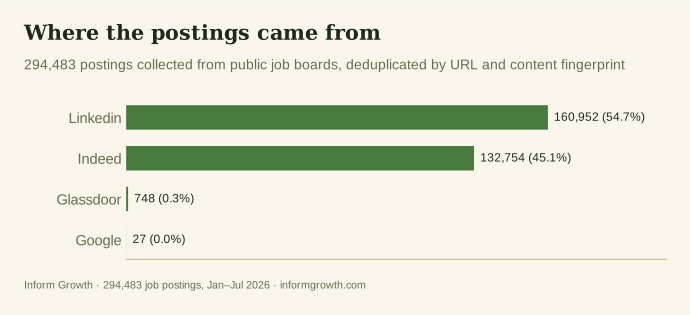
Where the postings came from.
The gap in the data. We paused collection during April and May 2026. Trend claims in this report therefore compare February against June and July, hold the role class constant, and are tested for significance. We would rather show you the gap than smooth over it, and the charts mark it visibly.
The screening. Job boards return broad matches, so every posting was classified by title: 15,369 matched our target role classes exactly, 82,225 were GTM-adjacent titles, and 196,889 were unrelated results (store managers, software engineers) that we excluded from role-level claims. Text analysis ran on the 96,328 target and adjacent postings with English descriptions of at least 300 characters. Every number below traces to that population or a stated subset of it.
Key findings
- The median Revenue Operations job description names 3 distinct software tools, and 68% contain integration-pain language: single source of truth, disparate systems, data hygiene, migrations, syncing between platforms. RevOps is the most integration-burdened role companies hire for.
- Excel is the second most-named tool in ops and GTM hiring in 2026, appearing 14,252 times, behind only Salesforce (21,997) and ahead of HubSpot (7,019). Twenty years into the SaaS era, the spreadsheet is still the reconciliation layer.
- AI assistants are now named stack requirements. Claude appears in 2,279 postings, ChatGPT in 1,395, Microsoft Copilot in 1,149, making an AI assistant the sixth most-named tool overall.
- AI language in RevOps postings rose from 39% in February to 50% in July 2026, holding the role constant (significant, z = 2.6). The AI mandate is spreading fastest into exactly the role that carries the most integration pain.
- The more tools a posting names, the more likely it asks for AI. Postings naming no tools mention AI 16% of the time; postings naming five or more mention it 58% of the time. Tool sprawl and AI ambition are the same phenomenon seen from two angles.
- 58% of AI-mentioning postings are generic. They ask for "AI" without naming a single product or implementation technology. Even among dedicated AI leadership postings, 32% name nothing specific. The mandate is ahead of the spec.
- 200 companies posted an AI leadership role and an operations role in the same window, and about one in five AI leadership postings contains integration-pain language in the posting itself.
- The market pays for the gap. Within the same role, postings that mention AI advertise 14 to 24% higher salaries (significant in every class tested except RevOps, where AI is already table stakes). B2B companies mention AI at twice the rate of B2C, and the industry gradient runs from software (48%) to construction (4%).
A job posting is a confession
A job posting is the one public document where a company describes, in its own words, the work it cannot currently get done. Marketing pages describe aspiration; job descriptions describe friction. When thousands of companies independently write postings asking someone to "integrate and optimize data flows between HubSpot and other relevant systems" or to build "a single source of truth" for the third time, they are documenting the same structural gap from the inside.
That gap has a shape. Each new SaaS tool became another island: another login, another data model, another report that disagrees with the CRM. Analysis tools can see but not act. Action tools can execute but not judge. The space between them, where information becomes a decision and a decision becomes work, is not covered by software. So companies staff it. We call the roles that fill this space human middleware: people hired to move context between systems that do not talk to each other, and to turn what the tools report into what the business does.
The rest of this report measures that gap three ways: the tools named in the postings, the pain language the postings use, and how the arrival of AI is changing both.
Tool sprawl, measured
"Tool sprawl" usually shows up as a feeling: too many tabs, too many logins, numbers that never match. Job postings let us measure it.
The median Revenue Operations posting names 3 distinct SaaS products. Sales operations postings name a median of 2. The distribution has a long tail: over 2,600 postings enumerate six or more named systems the new hire is expected to own, administer, or reconcile.
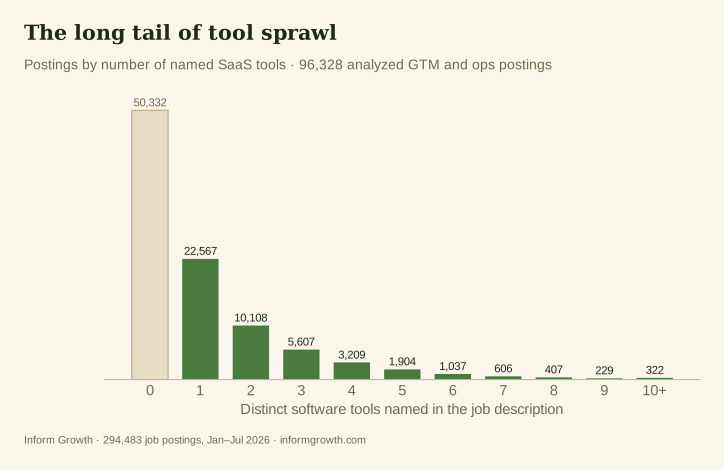
The most-named tools across all 96,328 analyzed postings:
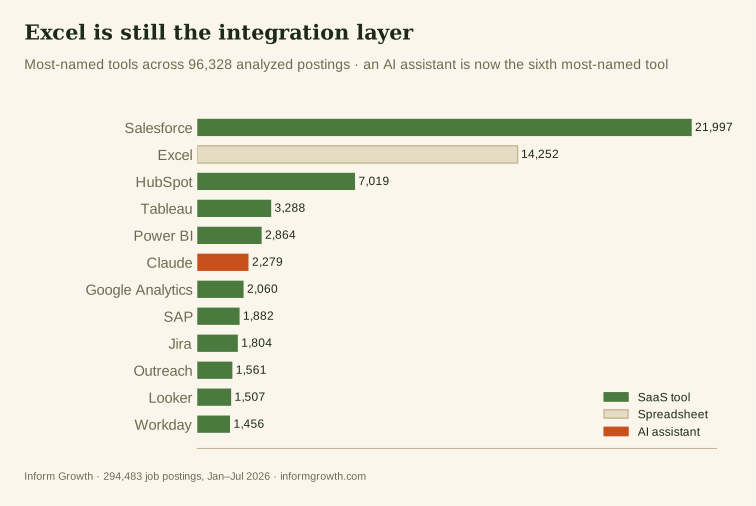
Two things stand out. First, Excel at number two. The world's most sophisticated GTM stacks still resolve to a spreadsheet when systems disagree, and companies write that into the job description. Second, an AI assistant at number six, above SAP and Jira. The stack is absorbing AI faster than the org chart is.
What companies are hiring ops roles to fix
Tools are the nouns of these postings. The pain language is the verbs, and it tells you what the hire is actually for.
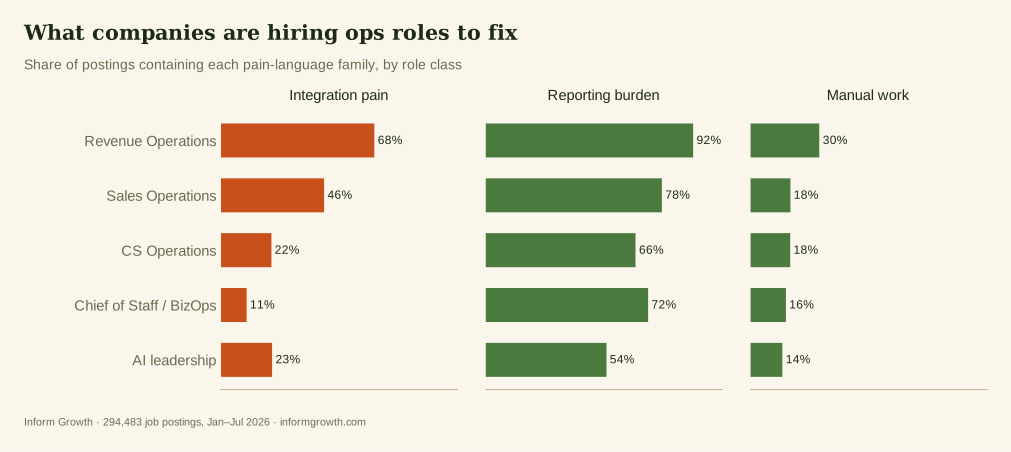
Read the chart left to right and a division of labor appears. Revenue Operations is the integration role: 68% of postings carry integration-pain language and 92% carry the reporting burden, dashboards, forecasting, executive reporting. Sales Operations is the systems-administration role: nearly half its postings talk about integration, anchored on the CRM. Chief of Staff and BizOps are the synthesis roles: only 11% integration pain, but 72% reporting burden and the highest rate of explicit decision language of any class we tracked (43.7%), finding what is scattered, making sense of it, packaging it so someone senior can decide.
And notice the last row. AI leadership postings themselves carry integration pain at 23%. One in five companies hiring an AI executive tells that executive, in the posting, that the systems do not connect. The problem the ops roles were hired to absorb is now appearing in the mandate of the role that is supposed to transcend it.
The same pain concentrates by segment and industry. B2B-context postings mention AI at 37.6%, twice the 19.7% rate of B2C. By industry, the gradient is stark:
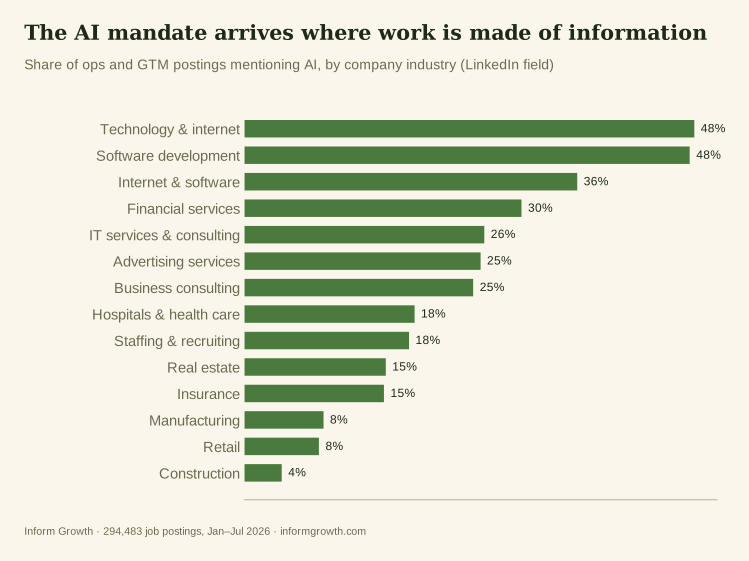
The AI mandate is arriving first where the work is already made of information, and that is also exactly where the tool sprawl is worst: software companies lead the integration-pain rate too, at 24% of postings. The industries with the most systems to connect are the ones most loudly asking for AI, and the ones quietly hiring the most people to do the connecting by hand.
The AI mandate is spreading into the plumbing roles
Hold Revenue Operations constant and watch the language change over the window:
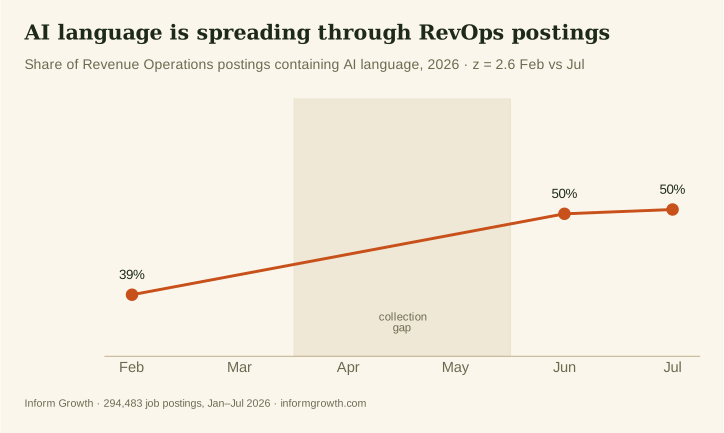
By July 2026, half of all RevOps postings mention AI. And 37.0% of RevOps postings contain both AI language and integration-pain language in the same document. That is the tension in one sentence: be strategic with AI, and also please fix the data flows.
The gradient that ties the whole thesis together is this one: the more tools a posting names, the more likely it asks for AI.
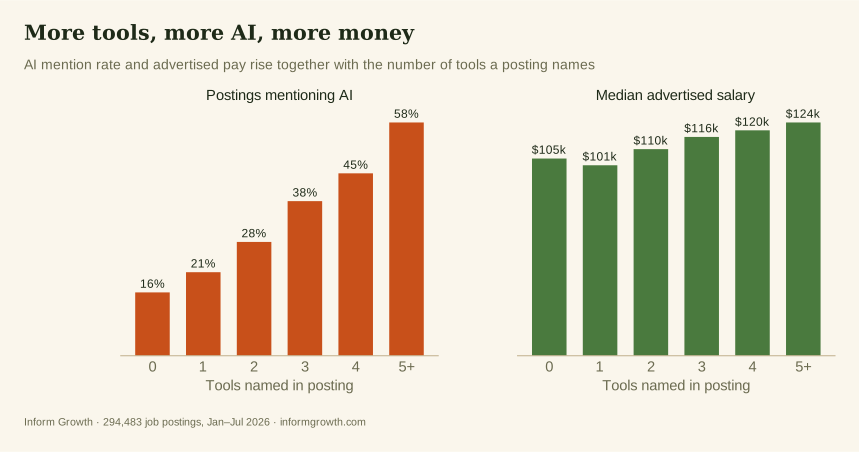
Companies are not asking for AI instead of the tool stack. They are asking for AI on top of the tool stack, from the same person, in the same posting. The plumbing work did not go away when the mandate arrived; the mandate landed on the people doing the plumbing.
The mandate is ahead of the spec
How specifically do companies say what they want when they ask for AI? We classified all 21,628 AI-mentioning postings:
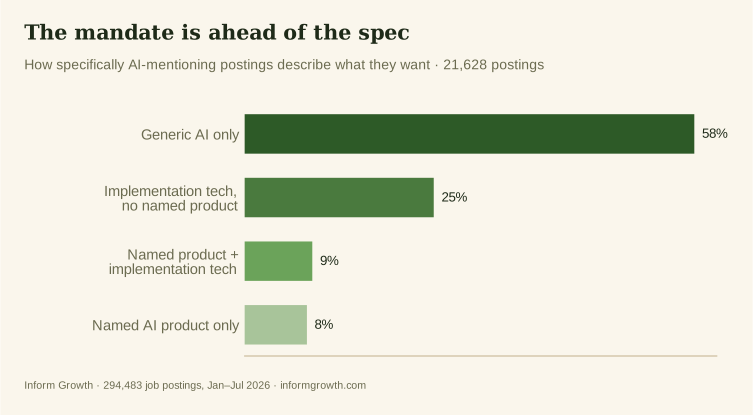
58% are generic: "leverage AI," "AI-driven," no named product, no implementation technology. Only 17% name a specific AI product. The implementation-level vocabulary is a snapshot of how far the market's language has actually traveled: agent and agentic language appears in 25.1% of AI postings, large language models in 12.0%, prompt engineering in 3.3%, vector databases in 3.4%, retrieval-augmented generation in 2.8%, and the Model Context Protocol, the emerging standard for connecting AI to business tools, already appears in 291 postings.
Even the dedicated AI leadership postings are vaguer than you would expect: 32% contain no specific product or technology at all. The company knows it wants AI. It cannot yet say what that means in its own systems. That is the mandate arriving before the plumbing, visible in the language itself.
The mandate has a geography
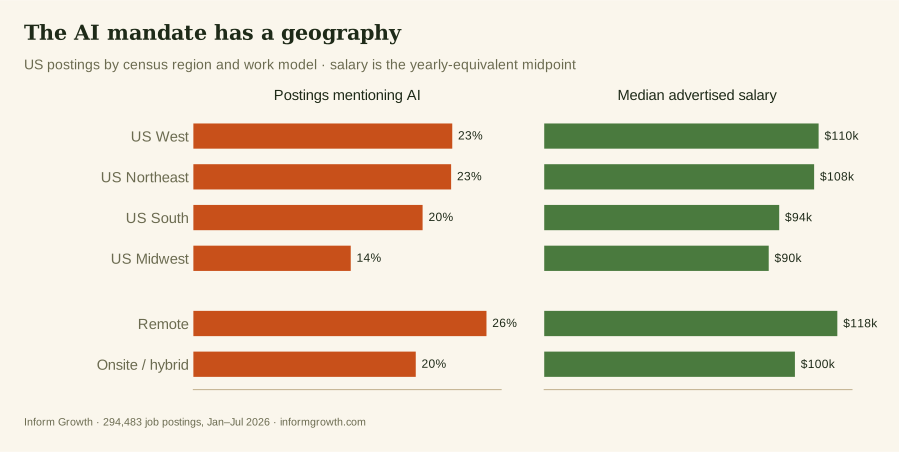
The US West and Northeast lead AI mention at 23% of ops postings; the Midwest trails at 14%, with the lowest advertised pay. Remote postings lead everything: 26% AI mention and a $117,500 median against $100,500 for onsite and hybrid roles. Companies hiring nationally for distributed ops roles are, on the evidence of their own postings, further along in absorbing the mandate than companies hiring locally.
The market prices the gap
We kept salary out of the headline deliberately; this is a story about work, not compensation. But the market's pricing confirms the pattern, so it belongs in the record. Within the same role class, postings that mention AI advertise higher pay: 24% higher in sales engineering, 16% in Sales Operations, 15% in Chief of Staff and BizOps roles, 14% in SDR/BDR, each significant by a rank test. These are associations in observed postings, not a controlled experiment; AI-mentioning postings likely also skew toward better-funded companies and more senior scopes. But the direction is consistent everywhere we can measure it.
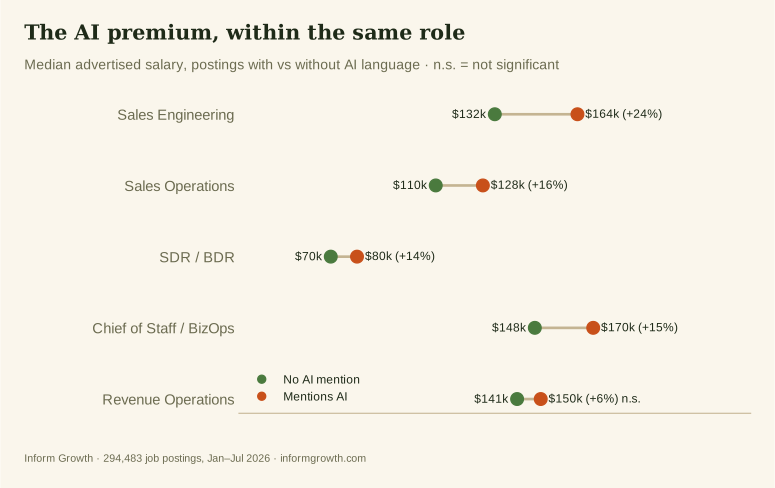
The one place the premium vanishes is Revenue Operations, up 6.4%, not significant, because AI mention no longer differentiates a RevOps posting at all: half of them have it. The premium migrates to wherever AI fluency is still scarce. Meanwhile the AI leadership roles themselves command a median of $210,000, the highest of any class we tracked, evidence of how much companies are willing to invest in the mandate itself.
What this data cannot say
Original research earns trust by stating its own limits, so here are ours.
It measures language, not reality. A posting that says "single source of truth" documents a stated need, not the internal state of the company's systems. Postings are also marketing documents and inflate scope.
The dictionary undercounts. Tool extraction counts named products. A posting that says "our CRM" without naming it counts as zero tools. Our tool-sprawl numbers are floors, not ceilings.
The salary findings are associations. We cannot separate the AI premium from seniority, company funding, or scope within a role class. We report medians and rank tests, not causal claims.
The trend window is short and has a hole. Seven months of collection with a two-month pause supports February-versus-summer comparisons within a fixed role class, tested for significance. It does not support seasonal claims or year-over-year claims.
The population is what job boards return. LinkedIn and Indeed skew toward certain company sizes and sectors. Staffing-agency postings (4.3%, flagged and excluded from company-level claims) and cross-board reposts (about 11%, collapsed where we count unique jobs) are handled, but board composition itself is a bias we cannot fully remove.
Conclusion: AI strategy is still a separate decision from the plumbing
Put the pieces side by side.
Companies are hiring AI leadership at the top of the market, and a fifth of those postings admit in writing that the systems underneath do not connect. Half of RevOps postings now carry the AI mandate, and two thirds of them carry integration pain; the same person is being asked to be strategic with AI and to fix the data flows by hand. 58% of all AI asks are generic, because the company has committed to the direction without yet being able to name the mechanism. And 200 companies in our window were hiring for the ambition and the plumbing at the same time, in separate postings, as if they were separate problems.
That is the finding, stated plainly: in the 2026 hiring record, AI strategy and operational infrastructure are still being treated as independent decisions, and the job postings themselves show they cannot be.
What these roles are actually for
Strip the job titles away and read what the postings ask people to do, and nearly all of it sorts into three kinds of work. Find: pull information out of the systems where it lives, the CRM, the warehouse, the inbox, the spreadsheet that disagrees with all of them. Consume: make sense of what was found, reconcile it, compress it into the dashboard or the board deck. Create: turn the decision into work product, the report, the workflow, the follow-up. The pain-language chart earlier in this report is those three bottlenecks measured: integration pain is the cost of finding, reporting burden is the cost of consuming, manual work is the cost of creating.
What sits between those three is the thing companies actually want from these hires, and the postings say so out loud: 43.7% of Chief of Staff and BizOps postings, the highest of any class, use explicit decision language. Faster decisions, better decisions, decisions leadership can trust. The bottleneck on business performance in these postings is not headcount and it is not intelligence. It is decision throughput, and companies are buying it the only way the current market knows how to sell it: one salaried human at a time, wrapped around systems that do not talk to each other.
The role nobody is hiring for
Look at what is present in the hiring record, and then at what is absent.
Present: the mandate (AI leadership at a $210,000 median), the manual labor (tens of thousands of ops postings carrying integration pain), and the ambient pressure (AI language in half of RevOps postings and rising). Absent: almost anyone whose job is the connection layer itself. Only 17% of AI-mentioning postings can name a product. Implementation vocabulary is thin: retrieval in under 3%, the Model Context Protocol, the standard specifically designed to connect AI to business tools, in 291 postings out of 294,483. The market has priced the ambition and the labor, but it has barely begun to define the role that would make one serve the other.
This is the shape we set out to test, and the data is consistent with it: a public AI commitment, operational complexity that AI tooling alone does not resolve, and no owner for the infrastructure in between. Companies in that position do not need another generic AI hire or another human to stand between the systems. They need the mandate and the plumbing to become the same project.
Where this goes
The convergence is already visible at the edges of the data: AI assistants entering the named tool stack at rank six, agentic language in a quarter of AI asks, protocol vocabulary starting to appear. Within a few quarters, we expect the generic share of AI asks to fall, the specific share to rise, and a new kind of posting to emerge, one that reads less like "leverage AI" and more like "own the layer that connects our AI to our systems, governed and auditable." The companies that get there first will spend their ops salaries on judgment instead of glue. The rest will keep paying people to be the integration layer and calling it an AI strategy.
This research is by Inform Growth. We build and run managed AI infrastructure for companies whose ambition has outrun their plumbing, and the fastest way to see where you stand is the way this report was built: look at where finding, consuming, and creating eat your team's time before a decision gets made. If you want to compare notes on what that looks like in your own operation, let's talk. Start at informgrowth.com.
Methodology
Between January 4 and July 26, 2026, with a collection pause in April and May, we collected 294,483 job postings via automated scraping of public job boards (LinkedIn 54.7%, Indeed 45.1%, Glassdoor and others under 1%), using the fixed query set listed at the top of this report.
Deduplication was enforced at collection time by URL and content fingerprint; zero exact duplicates exist in the dataset. Cross-board reposts (identical title and company on multiple boards) account for roughly 11% of rows and are collapsed where we report unique jobs. Company counts use normalized company names (68,618 unique companies).
Every posting was classified by title into target roles (15,369), GTM-adjacent roles (82,225), and non-target board noise (196,889, excluded from role-level claims). Text analysis ran on target and adjacent postings with English descriptions of at least 300 characters: 96,328 postings.
Tool mentions were extracted with a curated dictionary of about 120 named SaaS products with aliases; ambiguous names such as "Outreach" and "Segment" are counted only when the surrounding text contains tooling context, a rule added after manual sampling showed roughly half of bare matches were false positives. SQL and Python are tracked as skills and excluded from tool counts. Phrase-family statistics (AI language, integration pain, manual work, reporting burden, decision language) use pattern matching over full description text. AI specificity classifies each AI-mentioning posting by named products and implementation terminology (agents, LLMs, RAG, MCP, prompt engineering, fine-tuning, vector databases), with patterns constrained to avoid false positives on ambiguous acronyms.
Salary figures use posted ranges normalized to yearly-equivalent midpoints, outliers outside $10,000 to $1,500,000 removed; 84,201 postings carry usable yearly salary data. Location uses the board-provided location field parsed to US census regions; remote status uses the board's remote flag. B2B and B2C are classified from description language; postings matching neither or both are excluded from the two-segment comparison. Industry uses the LinkedIn company-industry field, present on 72% of analyzed postings.
Comparative claims are tested: the RevOps AI trend by two-proportion z-test (z = 2.6), salary comparisons by Mann-Whitney rank test (z between 4.3 and 6.7). Staffing-agency postings (4.3%) are excluded from company-level claims.
The analysis pipeline is deterministic (dictionary and pattern matching, no model-generated statistics) and re-runnable end to end.
Questions about the data, requests for specific cuts, or the report as a PDF: informgrowth.com.
Frequently asked questions
What is an AI mandate without plumbing?
An AI mandate without plumbing is when a company commits publicly to AI while still hiring people to move data between systems by hand. In the 2026 hiring record, 200 companies posted an AI leadership role and an operations role in the same window, and 22.7% of AI leadership postings themselves contain integration-pain language.
How many job postings were analyzed?
294,483 job postings were collected from public job boards between January 4 and July 26, 2026, with a collection pause in April and May. Text analysis ran on the 96,328 postings in target and GTM-adjacent roles with English descriptions of at least 300 characters.
What share of job postings mention AI in 2026?
22.5% of analyzed operations and go-to-market postings mention AI. Of those, 58.5% are generic — they ask for AI without naming a single product or implementation technology.
Which role carries the most integration pain?
Revenue Operations. 68% of RevOps postings contain integration-pain language such as single source of truth, disparate systems, and data hygiene, and 92% carry reporting-burden language — both the highest of any role class measured.